
Searching Williamson County Criminal Dockets
Begin with whatever court is printed on the notice, bond paper, or citation in hand. Williamson County posts two main entry points for court records. The Williamson County Court Case gateway routes visitors into the local records path. The Williamson Records Inquiry page sorts searches by court location. Its menu offers Criminal Case Records. It also lists grouped district docket locations, single tiles for some district courts, and several Courts at Law. The public form has redirected to a login path at times. So the controls on offer can shift. Treat any broad name field, date filter, or download button as optional rather than guaranteed.
Keep the cause number, court number, filing year, and party name from the official notice close by. A full identifier beats a wide name search every time. If the portal returns nothing, check the court level before fiddling with spelling. A blank screen can mean the wrong tile, a brand-new filing, restricted access, or a portal change.
- Identify district court, County Court at Law, Justice Court, or municipal court from the source document.
- Open the matching Odyssey location or the issuing court's own portal.
- Use the complete cause or citation number when that option is offered.
- Compare court assignment, charge, settings, and status with the notice.
- Ask the custodian clerk for the named document when a certified record is required.
Williamson Criminal Dockets Across Seven Courts
Felony routing starts with the Williamson County District Courts. The current county directory lists seven of them. These are the 26th, 277th, 368th, 395th, 425th, 480th, and 512th District Courts. Criminal assignments show up for the 26th, 277th, 368th, and 512th. The 277th also handles juvenile matters, and juvenile records are not open to unrestricted public access as a result. On the Odyssey menu, some courts share one search tile while others stand alone. So the court assignment itself is part of the search key.
Before trusting an old case note, check the District Courts directory. It shows the seven-court structure used for this routing.
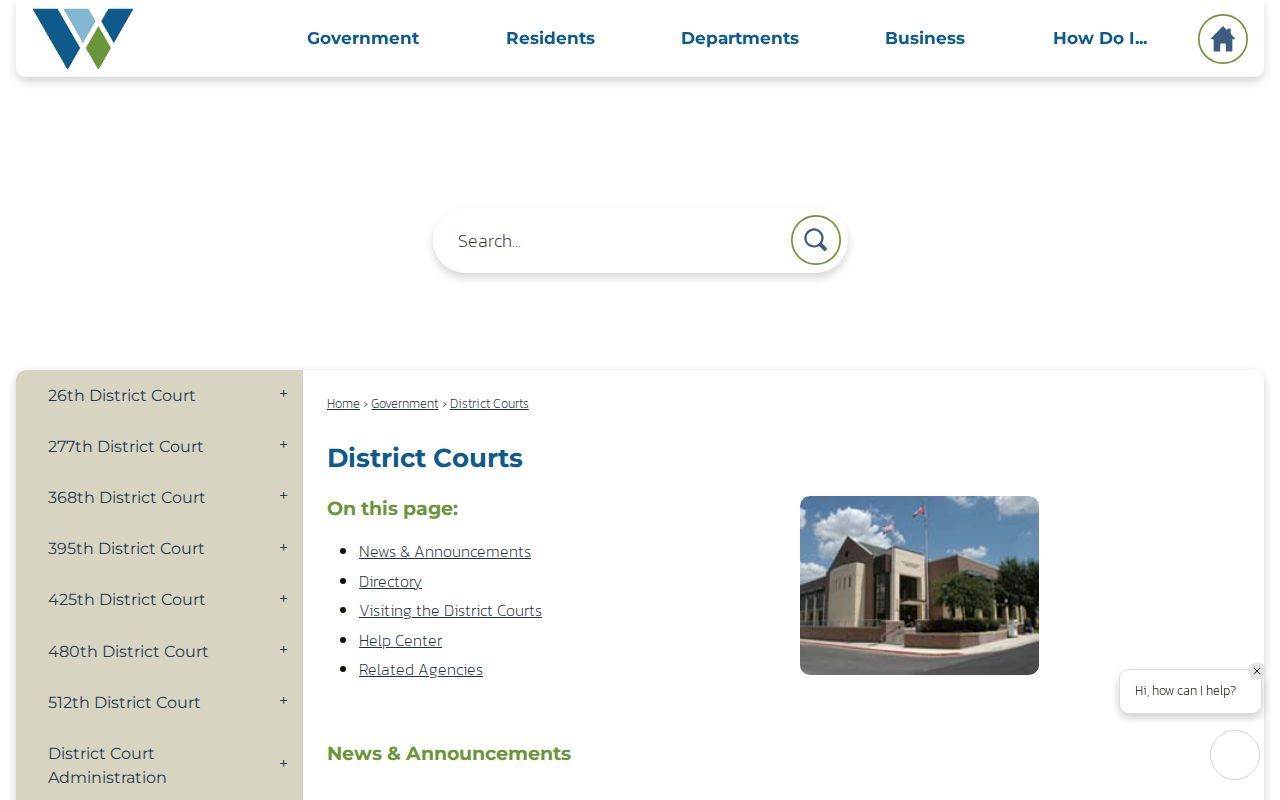
Recheck that list after any reassignment. The docket follows the assigned court, not a broad county label, so a case can move with its judge.
Inside a Williamson County Criminal Docket
Think of the register as a timeline, not the whole story. Read each line by date and by event type. A charge line names the accusation the court recorded. A setting marks a planned court event. Motions record requests; orders record what the judge directed. Keep those meanings apart. "Filed" never means "granted," and a reset is not a dismissal.
| Cause number | The court's exact identifier, including original punctuation or prefix. |
|---|---|
| Court and case type | The assigned district, CCL, JP, or city court and criminal category. |
| Charge and filing | The offense or statute description and recorded filing or event date. |
| Setting and plea | Arraignment, pretrial, trial, or other event and any plea entered. |
| Motion and order | A party's request and the court's separate ruling, when one exists. |
| Disposition | The recorded resolution, judgment, sentence, dismissal, or status. |
A document link can be missing even when the event is public. Lisa David, Williamson County District Clerk, holds the district-court papers. Nancy E. Rister, Williamson County Clerk, keeps the County Courts at Law records. Ask the right office for the exact order or judgment.
Williamson Misdemeanor Docket Routing
Class A and B misdemeanors belong in Williamson County Courts at Law 1–5, not the district felony route, and the County Clerk keeps those records. Odyssey gives criminal and civil docket locations for CCL1, CCL2, CCL3, and CCL5 in its menu. CCL4 appears in the official directory but has no separate search tile, so the County Clerk fallback matters when it goes missing.
- CCL
- County Court at Law, which hears Class A and B misdemeanors.
- Setting
- A scheduled event, not proof that a plea, trial, or ruling occurred.
- Disposition
- The recorded outcome that resolves a charge or case component.
- Bond event
- An entry tied to release terms; jail bond records remain a separate channel.
For a missing assignment, call the County Clerk Courts Division at 512-943-1150. Setting lines are 512-943-1201 for CCL1, 512-943-1410 for CCL2, 512-943-1160 for CCL3, 512-943-1681 for CCL4, and 512-943-3671 for CCL5. Staff confirm settings, but they do not certify records.
How a Criminal Case Moves
A Williamson County criminal docket grows entry by entry. The clerk records each filed or court-generated event. Early lines often show the charge and bond activity. Arraignment covers the charge, rights, and plea procedure. Pretrial entries may log scheduling, motions, discovery, or program matters. A plea or trial can end in judgment and sentence. Dismissal is its own disposition, and it must appear in the official record.
Docket flow: Charge Filed › Arraignment › Pretrial › Plea or Trial › Disposition › Sentencing
Treat the sequence as a reading aid, not a promise that every case carries each label. Some events repeat. Others arrive by written order. After a reset, the old setting stays in the history, so record both dates and confirm the newest one with the named court before anyone must appear.
Williamson Criminal Specialty Docket Labels
Named programs add labels that may not look like a standard pretrial or plea setting. Williamson County ties Felony Mental Health to the 26th District Court. Transformative Justice belongs to the 277th. Felony DWI sits with the 368th. County Court at Law 2 materials list DWI/Drug Court and Veterans Treatment Court as well. The labels help explain an event or assignment, but the case itself stays with its assigned district or county court.
Program record caution: A public case-register entry does not expose every treatment, assessment, or program record. Use the official court and lawful clerk channel.
Never infer eligibility, completion, or a result from a short label. Use the event date and court assignment to guide follow-up, and let an accessible order supply the operative terms.
Courts That Hold Criminal Dockets
Criminal cases in Williamson County travel one of four routes. Felonies belong to the district courts. The District Clerk holds those dockets. Class A and B misdemeanors go to the Courts at Law, where the County Clerk keeps the records. Fine-only Class C cases land in the Justice Courts of Precincts 1–4. Municipal courts take city ordinance matters plus concurrent fine-only state offenses. Whichever court issued the case is where the record lives.
| Case level | Starting court | Record channel |
|---|---|---|
| Felony | Assigned district court | District Clerk and district Odyssey location |
| Class A or B misdemeanor | County Court at Law 1–5 | County Clerk and matching CCL location |
| Precinct fine-only case | Justice Court 1–4 | That precinct clerk and calendar |
| City citation | Issuing municipal court | City clerk or citation portal |
City portals have their own limits. A search there may want a citation number, birth date, license, or vehicle details. That only checks one city case, not a county-wide criminal docket search. Jail and jail bond records sit apart from the court docket too.
Missing Williamson Criminal Docket Results
A blank result screen does not mean no case exists. First match the issuing court and cause number against the Odyssey tile. Then copy the punctuation exactly as it appears on the notice. A brand-new filing may not be indexed yet, and sealed, expunged, juvenile, or restricted matters stay hidden from anonymous access.
For district records, call the District Clerk at 512-943-1212. The official form can be emailed to dcrequest@wilco.org, faxed to 512-943-1222, hand-delivered to 405 Martin Luther King Street, or mailed to Attn: DC Records, P.O. Box 24, Georgetown, TX 78627. County misdemeanor questions start with the County Clerk Courts Division. re:SearchTX offers a second statewide route for eligible non-sensitive material, though it does not carry every Williamson County trial record.
Note: Give the exact cause number and document name; a docket search alone does not produce a certified copy.
Sealed Dockets and Public Access
Access to a court record depends on the record itself and the law that governs it. Texas does not run judicial records and court case records through one shared request process. The Texas Judicial Branch explains that Rule 12 covers judicial records other than case records. Case files, by contrast, are governed by court rules, statutes, and common law through the clerk. So a visible Williamson County entry does not make every document public.
Key Rules:
Texas Rules of Judicial Administration Rule 12 generally opens covered judicial records but provides exceptions and a request process.
Texas Family Code Chapter 58 places special limits on juvenile-record access.
Texas Code of Criminal Procedure Chapter 55A governs expunction, including access after an order.
The District Clerk will not hand out sealed documents without authority from a court, law, or order. The lawful process is the right path. Rebuilding a record from old copies is not.
Williamson Criminal Docket Scale
The FY 2025–26 adopted Williamson County budget reports criminal measures for its stated department scope. The total docket figures stand at 5,092 for FY23 actual and 7,793 for FY24 actual. The FY25 estimate reaches 13,786. Disposed counts run 2,614, 4,114, and 5,158 across those years. Active end-of-year counts are 2,267, 2,918, and an estimated 8,222.
Treat these as planning measures. They do not count every district, CCL, JP, municipal, or federal case, and they support no conclusion about a person or crime trend. The real lesson: a Williamson County docket search works best with a precise court and cause number.